‘Living vegetables’ made their way onto the dining table
By Miao Bei
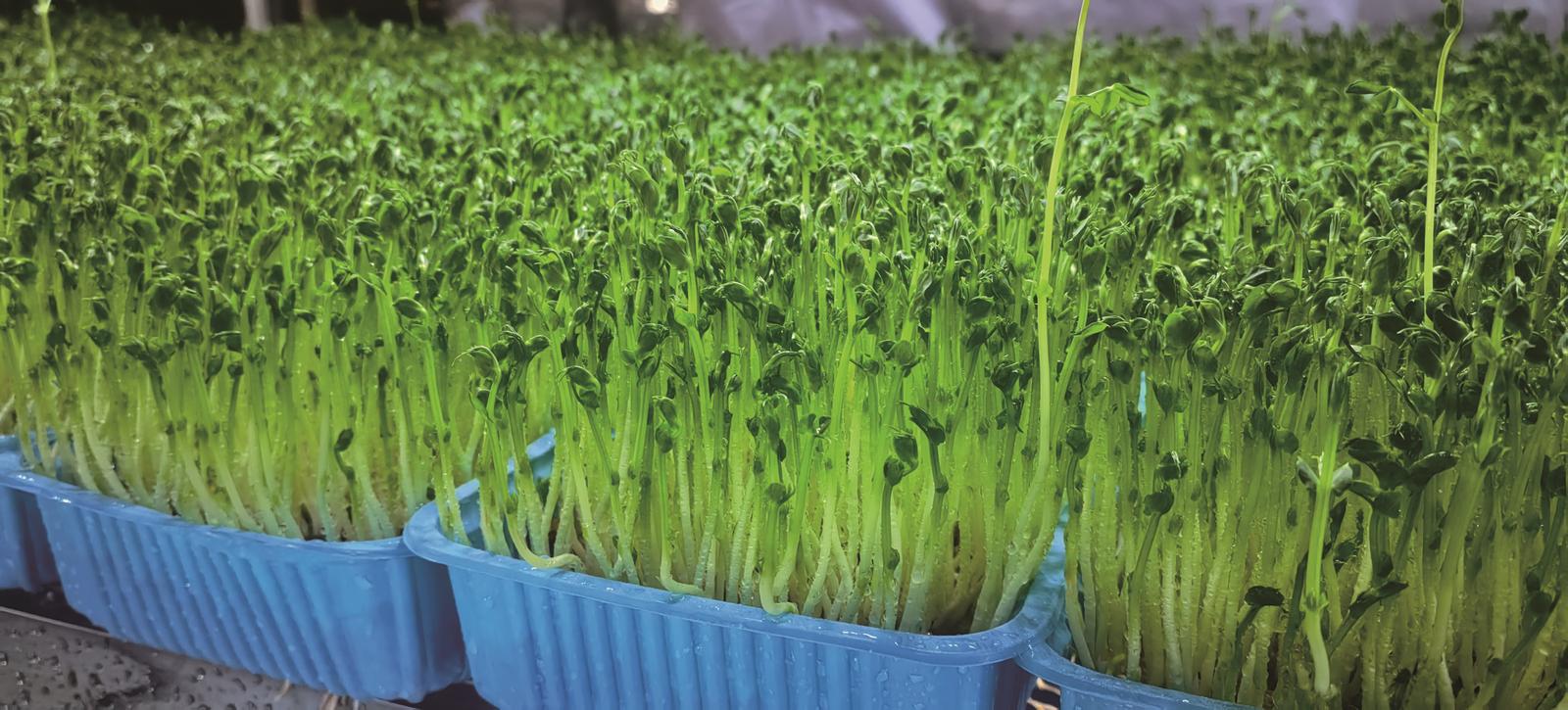
Recently, in many citizens’ grocery baskets, there is now a distinctive touch of ‘fresh green’ —— boxes of living sprout vegetables with snow-white roots and tender stems and leaves.
‘You can even keep it as a bonsai for a few days after buying it, just snip off what you need, and enjoy the freshness right before your eyes,’ said Ms. Chen, a citizen who was purchasing.
The touch of ‘Spring Festival green’ does not come from distant suburban fields, but is produced inside factory workshops in Chongchuan District.
Sprouts, commonly known as ‘ruyi vegetables,’ do not refer to any single specific vegetable. Rather, they are a collective term for the edible young shoots cultivated from the seeds of various grains and legumes, and are often praised as ‘living vegetables.’ Their rising popularity reflects modern consumers’ increasingly refined pursuit of healthy eating.
The ‘entire life’ of sprouts is completely isolated from external soil and climatic conditions. They are grown in special seedling trays. The only ‘food’ is clear water. The only ‘environment’ is precisely controlled temperature and humidity.
‘The core principle is simply purified water and a sterile environment, with temperature, lighting, and humidity intelligently controlled so that the vegetables grow in absolute cleanliness.’ Xu Qinghua, the person in charge of Nantong Yinghe Agricultural Technology Co., Ltd., said that the growth cycle takes 9 to 10 days, which is slow and costly, but it ensures the naturalness and authenticity of the food.
‘This type of sprouts is fresh and good-looking. Customers, especially young people, like to eat it. It has become a regular dish in our restaurant,’ said the manager of a hot pot restaurant in the city.
‘The sprouts are harvested and packaged in the early morning, delivered at four or five in the morning, and on the table by noon,’ said Xu Qinghua. More importantly, the price is quite affordable: each box weighs between 400 and 500 grams, with an average retail price of 5 to 6 yuan.
【背景阅读】
“活体蔬菜”走上餐桌
近日,不少市民的菜篮子里,多了一抹特别的“新绿”——一盒盒根系洁白、茎叶鲜嫩的活体芽苗菜。
“买回去还能当盆景养两天,随吃随剪,新鲜看得见。”正在选购的市民陈女士介绍。
这抹“新春绿”,并非来自远郊的田间地头,而是产自崇川区的厂房内。
芽苗菜,俗称如意菜,并非某种特定蔬菜,而是各种谷类、豆类种子培育出的可食用嫩苗的统称,被誉为“活体蔬菜”。其走俏的背后,是现代人对健康饮食日益精细的追求。
芽苗菜的“一生”完全与外界土壤和气候隔离。它们生长在特制的育苗盘里,唯一的“食物”是清水,唯一的“环境”是精准控制的温湿度。
“核心就是纯水加无菌环境,智能控制温度、光照、湿度,让菜在绝对干净中生长。”南通盈禾农业科技有限公司负责人徐庆华介绍,生长周期需9到10天,虽然慢、成本高,但保证了食材的自然与本真。
“这种芽苗菜新鲜、品相好,消费者特别是年轻人喜欢吃,已经成了店里的常备菜。”市区一家火锅店负责人说。
“当天凌晨采收、分装,四五点配送,中午就能上桌。”徐庆华说,更关键的是,其价格颇为亲民,每盒重400克至500克,市场售价平均5至6元。