China is not only a market, but also an engine of innovation
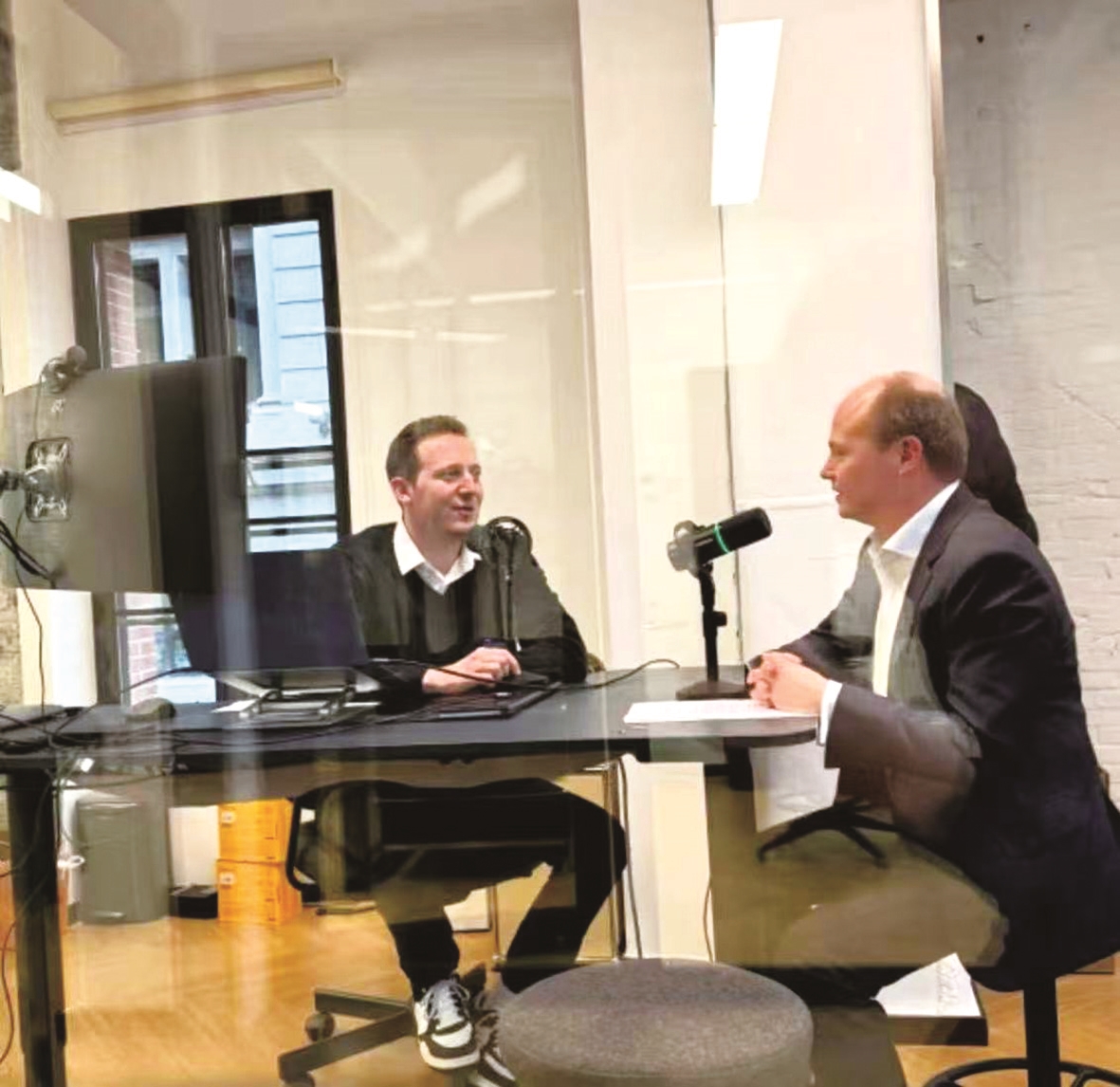
Marc Horn(on the right)
By Miao Bei, Si Zhanwei and Chen Ke
China is not only a sales market to Merck, but also an engine of innovation.’ In a recent podcast interview focusing on Sino-German business, He Muqi (Marc Horn), the former president of Merck China, said.
The podcast Made in China has attracted a lot of attention overseas. In the program, Marc Horn reviewed in detail Merck's investment decision in Nantong, regarding it as a core case of Merck's localization strategy in China.
Marc Horn introduced that in the strategic transformation in the second decade of the 21st century, Merck decided to establish a production base in Nantong, focusing on the production of products for uterine fibroids, diabetes, and cardiovascular diseases. He repeatedly praised the Nantong Economic and Technological Development Area for being ‘swift to act, decisive in support and sincere in cooperation’in attracting major projects. It was precisely this professional and efficient government service that led Merck to set aside other competing cities and ultimately choose Nantong.
In 2014, Merck built a new integrated pharmaceutical production base in Nantong, which was its second-largest pharmaceutical production base in the world. It was on the basis of this deep mutual trust that Merck made five consecutive investments in the Nantong Economic and Technological Development Area over the following decade, successively establishing projects such as Merck Life Science Center, the Pharmaceutical and Healthcare Logistics Center and the Life Science Reagent Production Base. The accumulated investment has reached nearly 3.3 billion yuan, accounting for about half of its total investment in China. In 2025, the operating revenue of the projects invested by Merck in Nantong reached 9.9 billion yuan, and the total amount of tax was 300 million yuan.
Marc Horn summarized the core of Merck's strategic transformation in China as ‘from an importer to a local innovation participant.’ He acknowledged that Merck China used to serve primarily as an importer in the past, and the key challenge at that time was ‘how to reposition itself in China and truly build a localized business layout.’ However, ‘China’s pace of innovation, market demand, and maturity of its industrial chain have all advanced to the forefront of the world.’ If the company remains stuck in its old model, it ‘will gradually lose its competitiveness.’
‘Merck's advantage lies in cutting-edge technology and global standards, while China's advantage lies in its industrial scale, application scenarios, and execution efficiency. The integration of the two can generate enormous value,’ said Marc Horn. During the podcast, he reaffirmed that Merck’s commitment to the Chinese market is one of long-term investment, rather than short-term performance orientation. ‘As a company with more than 350 years of history, we view markets over a horizon of ten, twenty, or even a hundred years.’ He stated that China is already Merck’s second-largest market globally, and in the future it will upgrade from ‘innovating for China’ to ‘a core source of innovation for Merck worldwide.’
【背景阅读】
默克中国前总裁何慕麒在播客中称赞
中国不仅是市场,更是创新引擎
南通吸引默克近33亿元投资成其全球第二大医药生产中心
“中国对默克来说不仅是一个销售市场,更是创新的引擎。”在近日一期聚焦中德商业的访谈播客中,刚刚卸任的默克中国总裁何慕麒(Marc Horn)系统阐述了这家拥有350余年历史的德国企业对华战略的核心定位。
这档名为《中国制造》(Made in China)的播客在海外颇受关注。何慕麒在节目中详细回顾了默克在南通的投资决策,将其作为默克在华本土化战略的核心案例。
何慕麒介绍,默克在21世纪第二个十年的战略转型中,决定在南通建立生产基地,聚焦子宫肌瘤、糖尿病、心血管领域的产品生产。他多次称赞南通开发区在重大项目招引中“下手快、力度大、诚意足”,正是这种专业高效的政务服务,让默克排除其他竞争城市、最终选择南通。2014年,默克在南通新建一体化制药生产基地,成为其全球第二大的制药基地。正是基于这份深厚互信,默克此后十余年间在南通开发区实现“五连投”,先后设立生命科学中心、医药健康物流中心、生命科学试剂生产基地等项目,累计投资近33亿元,占其在华总投资的半壁江山。2025年,默克在通投资项目营业收入达99亿元,税收总额3亿元。
何慕麒用“从进口商到本土创新参与者”概括默克在华战略转型的核心。他坦言,过去默克中国的核心角色是“进口商”,当时的核心问题是“如何在中国重新定位,真正打造本土化的业务布局”。但“中国的创新节奏、市场需求、产业链成熟度,都已经走到了世界前列”,如果企业仍然停留在过去的模式,“就会逐渐失去竞争力。”
“默克的优势是前沿技术与全球标准,中国的优势是产业规模、应用场景和执行效率,两者结合可以产生巨大的价值。”何慕麒说。在播客中,他重申默克对中国市场的承诺是“长期主义的投入”,不是短期业绩导向。“作为一家拥有350多年历史的企业,我们看待市场的维度是十年、二十年甚至上百年。”他称,中国目前已是默克全球第二大市场,未来将“从‘为中国创新’,升级为‘默克全球核心的创新源泉’”。