Jiangsu Shipping College ‘moved’ the classes to Indonesia
By Gao Yang
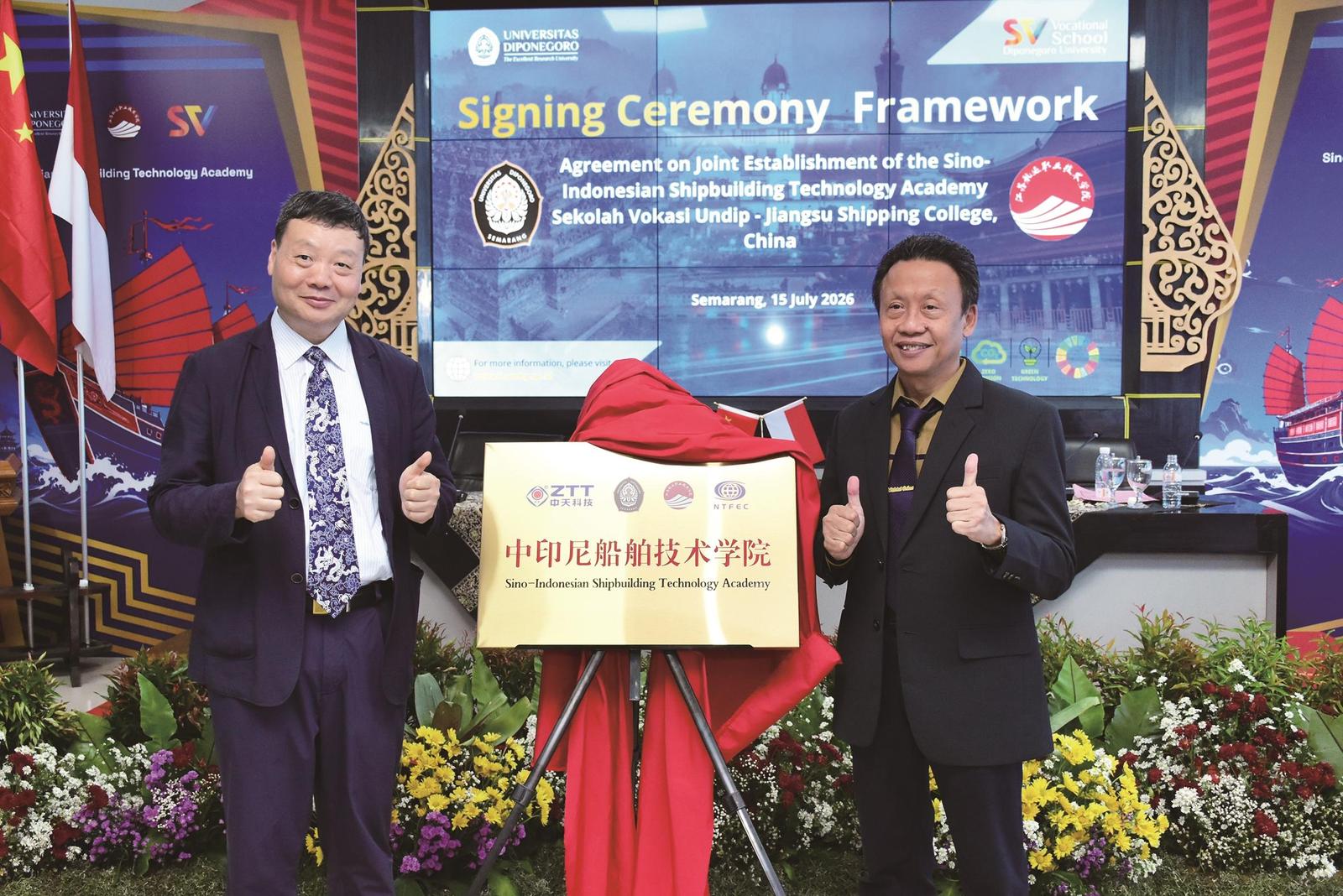
Recently, Jiangsu Shipping College and Diponegoro University from Indonesia signed an agreement. Sino-Indonesia Shipbuilding Technology Academy was founded.
‘The Indonesian workers pray every day and their Ramadan has special schedules. There are also considerations regarding whether the name card is printed in Chinese, English, or Indonesian.’ For a long time, Chinese-funded enterprises such as Zhongtian Technology faced an awkward dilemma in their Indonesian factories: they had production lines and machines, but they couldn't find suitable workers. A company executive vividly recalled the situation: ‘Inadequate skills and cultural barriers led to difficulties in recruiting and employing workers.’
Aiming at this pain point, Jiangsu Shipping College ‘moved’ the classes to the forefront of industrial needs. From the ‘cross-border school-enterprise community’ cooperation concept proposed in 2011, to the Indonesian Zheng He College established in 2024, to the just established Sino-Indonesia Shipbuilding Technology Academy, they are all aimed at cultivating local talents who are familiar with China's technical standards and corporate culture.
In the summer of 2024, 19-year-old Adela became one of the first batch of students in the ‘Modern Apprenticeship International Class’ at the Zheng He College in Indonesia. He still remembers his palms being sweaty when he first operated a ship engine simulator under the guidance of Chinese teachers. Just a few months later, he was already proficient in operating machinery, maintaining equipment, and troubleshooting various simulator malfunctions, and even received praise during his internship at a shipping company. ‘The teaching methods of the Chinese teachers are very special. We not only learn the theory but also practice,’ Adela said.
‘The curriculum follows industry standards. We teach what the companies need,’ explained Feng Mingbo, a resident teacher at the Zheng He College in Indonesia. He added that, based on local needs, the college launched a ‘Modern Apprenticeship International Class,’ offering a dual-diploma education—students study theory in Indonesia for one year, then practical skills in China for one year, followed by an internship at a Chinese-owned shipbuilding company in their third year, culminating in certification and employment. ‘At the end of four years, students receive both Chinese and Indonesian diplomas and can directly work on ships,’ Feng Mingbo said. The first batch enrolled 15 students, followed by 24 last year, and a third batch is already planned.
When Felia, a sophomore, first arrived in China, she couldn't speak a word of Chinese, but now she can communicate in daily life. Her course schedule includes nautical technology, marine engineering, Chinese language, and Tai Chi. She told reporters that she has learned a lot and mastered the operation of advanced machinery, adding, ‘I am full of confidence in my future career development.’
On the day the Sino-Indonesia Shipbuilding Technology Academy was founded, an exhibition on Zheng He's culture opened on the campus of Diponegoro University in Indonesia. The exhibition includes sections on Zheng He's maritime history, maritime technology, and the history of exchanges between the two countries, using old photographs and nautical charts to connect the deep historical ties between the two nations over six centuries. Many Indonesian teachers and students participated in fun games such as quizzes and riddles. Student Miika said, ‘It turns out that Chinese navigators had already traversed these seas before Columbus.’
Almost simultaneously, thousands of kilometers away in Nantong, another encounter was taking place. In a classroom at Jiangsu Shipping College, 24 teachers and students from the Sekolah Tinggi Ilmu Pelayaran were writing Chinese characters stroke by stroke on Xuan paper with calligraphy brushes. ‘This is my first time in China, and I think I've already fallen in love with it!’ said student Rama with a beaming smile. Their supervising teacher, Niken, also gave a thumbs up: ‘They have advanced teaching equipment and concepts, and the people here are dedicated and enthusiastic.’
【背景阅读】
江苏航运学院将课堂“搬”到印尼
近日,江苏航运职业技术学院与印尼迪波内戈罗大学签署协议,中印尼船舶技术学院成立。
“印尼工人每天都要祈祷、斋月作息特殊,姓名卡上印汉语、英语还是印尼语也有讲究。”中天科技等中资企业的印尼厂区曾长期面临一个尴尬的困境:生产线有了,机器运到了,却找不到合适的工人。相关企业负责人对当时的场景记忆犹新:“技能不达标、文化有隔阂,导致‘招工难、用工难’。”
瞄准这一痛点,江苏航运学院将课堂“搬”到了产业需求的最前端。从2011年提出的“跨境校企共同体”合作理念,到2024年成立的印尼郑和学院,再到刚刚落成的中印尼船舶技术学院,都是为了培养熟悉中国技术标准和企业文化的本土化人才。
2024年夏天,19岁的阿德拉成为印尼郑和学院“现代学徒制国际班”的首批学生之一。他还记得,第一次在中国老师的指导下操作船舶轮机模拟器时,自己手心里全是汗。短短几个月后,他已经能熟练地操作机械、维护设备、处理各种模拟设备故障,还在一家航运企业实习时受到了表扬。“中国老师的教学方法很特别,我们不仅要学习理论,还要动手操作。”阿德拉说。
“课程跟着企业标准走,企业需要什么,我们就教什么。”印尼郑和学院常驻教师冯明波介绍,根据当地实际需求,学院推出了“现代学徒制国际班”,开展“双文凭”学历教育——学生在印尼学一年理论,来中国学一年实操,大三进入中资船企实习,最后考证就业。“四年结束,学生能拿中国和印尼两张文凭,还能直接上船工作。”冯明波说,首批招了15人,去年又招了24人,第三批已在计划中。
正在读大二的菲丽雅刚来时一句中文都不会说,现在已经能够日常交流。她的课程表上,除了航海技术、轮机工程,还有汉语、太极拳。她告诉记者,她学习了很多知识,还掌握了先进机器的操作方法,“我对未来职业发展充满信心”。
中印尼船舶技术学院成立当天,一场郑和文化展在印尼迪波内戈罗大学校园内开展。展览包括郑和航海史、航海科技展、两国交往史等内容,用一张张老照片、一幅幅航海图,串联起两国六百年间的深厚渊源。现场,不少印尼师生还参加了知识问答、猜灯谜等趣味游戏。学生Miika说:“原来在哥伦布之前,中国的航海家已经穿越了这片海域。”
几乎同一时刻,数千公里之外的南通,另一场相遇也在发生。江苏航运学院的教室里,24名来自印尼高等航海学院的师生正手握毛笔,在宣纸上一笔一画写汉字。“我第一次来中国,我想我已经爱上这里了!”学生Rama笑容满面。带队老师Niken也竖起了大拇指:“这里有先进的教学设备和理念,人们工作认真、态度热情。”